
By Geoffrey Irving
The Quadrilateral Security Dialogue’s planned port initiative in Fiji offers the United States, Japan, Australia and India a strategic opportunity to counter China’ growing influence in the Pacific through a significant capital infrastructure project. But port project’s success will depend on overcoming logistical and financial hurdles, attracting private investment and expanding commercial partnerships in Fiji.
In May 2026, the United States and the Quad announced that it would work with Fiji on port development under the Quad Ports of the Future Partnership. The project aligns well with the Trump administration’s America First strategy as it gives Washington an opportunity to strengthen a key Pacific partner while improving commercial maritime infrastructure available to American and allied industry.
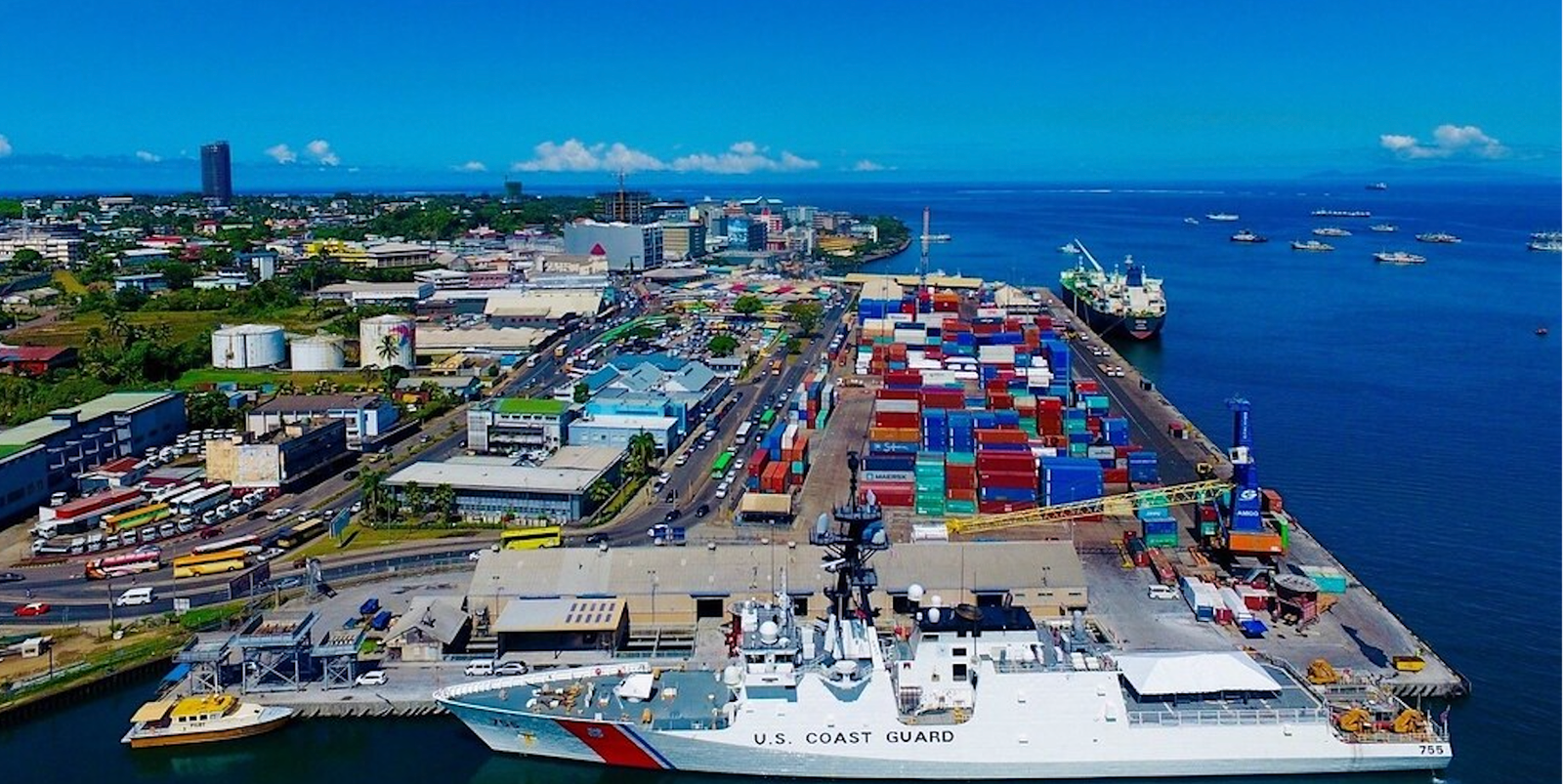
At present, Fiji’s main port of Suva is a highly congested, geographically constrained port with rusting ships scuttled throughout its bay. The value of the Quad project will depend on more than just expanded wharf infrastructure. Quad support should connect Suva’s redevelopment to landward storage and maritime navigational improvements while promoting additional commercial investments in Fiji to diversify risk.
A new test for the Quad
The Quad is a diplomatic partnership established in 2007. The elevation to leaders’ meetings in 2021 gave the Quad partnership greater political direction, and its agenda has since expanded to include maritime security and economic cooperation.
Despite its expanding regional role, the Quad has yet to undertake a major infrastructure development project. Earlier infrastructure initiatives have supported Palau’s Open RAN telecommunications network and undersea cable construction across the Pacific, but offer limited precedent for capital-intensive port redevelopment.
A plan beyond the wharf
A port is more than just a wharf. Any increase in ship berths at Suva Port will require a corresponding expansion of container storage lots inland. Fiji’s finance minister has already warned that Suva Port is approaching capacity. Any redevelopment must address the movement of cargo through the entire port area, including container yards and connections to the island’s road network. The geographic realities of Suva Port already severely constrain expansion, so additional landward development is necessary.
Draining Walu Bay is a potential solution. Walu Bay is a briny offshoot of Suva Bay that covers about 25 acres and constrains landward port expansion. Walu Bay thus deserves a specific land-use assessment in connection with the Suva Port project. Fiji and its partners should work with local leaders and communities to examine targeted reclamation as an option for additional container storage and logistics facilities.
In addition to land development, wreck removal from Suva Bay must be considered with any redevelopment plans. Suva Bay is littered with rusting, scuttled vessels that pose risks to increased vessel traffic in the bay. For example, in May 2026, the abandoned Spirit of Altruism dragged its anchor, struck a submerged wreck, and capsized near Draunibota Bay. A new port and expanded storage infrastructure will invite increased vessel traffic. If no action is taken to clear Suva Bay of its many wrecks, there will undoubtedly be an increased incidence of navigational and environmental incidents.
Fiji should also use diplomatic means to address the problem. An overwhelming majority of scuttled ships are formerly PRC-flagged vessels that are abandoned in Suva Bay and often avoid fines or penalties in so doing. This is both a diplomatic and environmental slight to Fiji that its government should address diplomatically with the PRC.
Government investment in Suva, commercial investment in Lautoka
The United States and the Quad partnership have already committed to a port expansion at Suva. However, to maximize the effect of the Quad partnership’s Suva port project, the United States should also pursue innovative diplomatic and commercial means to expand other port infrastructure in Fiji. The Trump Administration has made critical mineral supply chains a high priority for large industrial policy projects. From government stakes in domestic mining and refining companies to attracting foreign direct investment from allied critical minerals companies as part of larger trade deals, the Trump administration has shown a high degree of creativity to reduce America’s reliance on Chinese critical mineral chokepoints.
The administration’s critical mineral supply chain campaign should build upon the Quad’s Suva port project to concurrently pursue development of Fiji’s second port of Lautoka, leveraging existing critical mineral storage and processing infrastructure. While the Suva port project will be a government-financed capital project, concurrent development of Fiji’s second port of Lautoka should be a commercial-led brownfield development project.
To achieve this end, the United States should create an informal consortium of allied port developers, shipbuilders, and offshore critical mineral companies to evaluate a commercially led, government-coordinated redevelopment plan for Lautoka Port, encompassing the public Queens Wharf and the adjacent critical minerals facility.
Prove America can build again
The Quad’s Fiji port initiative is a sound strategic decision that should be paired with expanded commercial diplomacy to realize its full potential for anchoring American and allied influence in the Pacific where China has steadily expanded its economic influence. But strategic ambition will not guarantee success. A comprehensive approach should include a land-use assessment of Walu Bay, accelerated wreck removal in the harbor, and commercial redevelopment at Lautoka.
Most importantly, this project would give Fiji a credible alternative to Chinese investment and strengthen the commercial relationships that support American and allied influence in the Pacific. The project’s success should be measured not simply by modernized docks and expanded shipping capacity, but by whether it delivers lasting economic benefits for Fiji and strengthens the country’s commercial ties with the Quad nations. The larger strategic test is whether Washington and its partners can translate a single infrastructure project into a sustained regional commitment.
Geoffrey Irving is a nonresident scholar with the Technology and International Affairs Program at the Carnegie Endowment for International Peace and previously served on the National Security Council and with the United States Marine Corps.




