
By Alyssa I. Agard
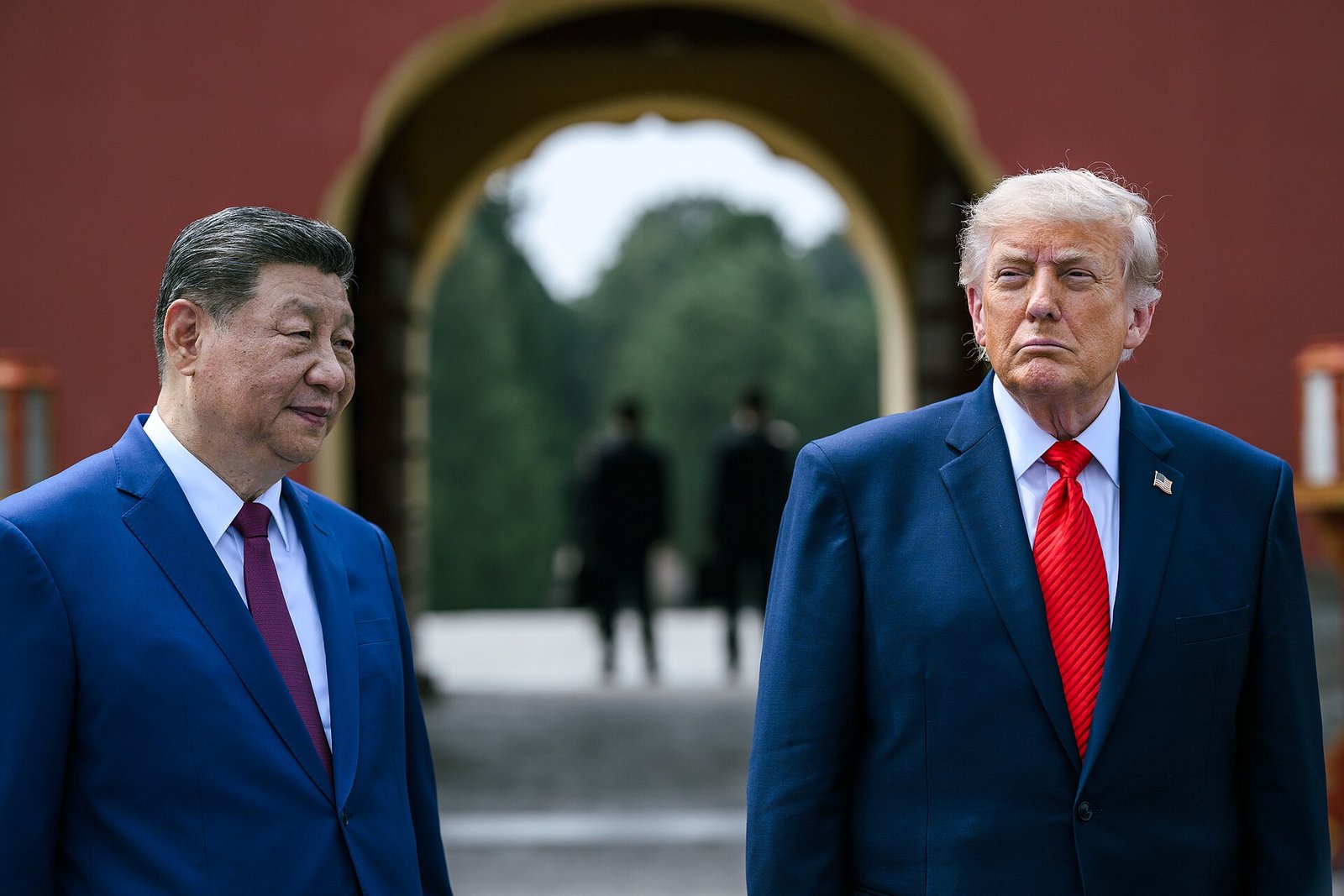
Presidents Xi Jinping and Donald Trump met in Beijing on May 14, 2026. The encounter marked the first state visit to China by an American president since 2017. The official Chinese readout characterized the bilateral relationship as moving toward “constructive strategic stability.” Yet beneath the ceremonial optics and diplomatic choreography, one issue loomed in its conspicuous absence: the South China Sea. Neither side publicly addressed the contested waterway, maritime coercion, or intensifying gray-zone confrontation in the East China Sea. This silence may prove as strategically significant as anything formally agreed.
What the Readouts Did Not Address
The summit agenda, as previewed by analysts at the Center for Strategic and International Studies, foregrounded several substantive topics. Anticipated items included rare earths, fentanyl precursors, artificial intelligence (AI) safety, the Iran conflict, the Strait of Hormuz, Russia and Ukraine, and Taiwan. Conspicuously absent from the pre-summit agenda were the South China Sea, the East China Sea, and Beijing’s expanding maritime gray-zone activity. The post-summit assessment issued by the same institution confirmed that these issues received no substantive engagement. Analysts further observed no indication that Beijing intended to reduce its military activities. The omission is not incidental, and it merits careful analytical attention.
The Three Sea Forces by the Numbers
CSIS Hidden Reach identifies the People’s Liberation Army (PLA) Navy (PLAN) as the world’s largest navy by hull count. A Council on Geostrategy policy paper identifies the China Coast Guard (CCG) as the world’s largest maritime law enforcement fleet. The most recent Department of Defense (DOD) Annual Report to Congress characterizes the People’s Armed Forces Maritime Militia (PAFMM) as a third sea force operating in coordination with the PLAN and CCG. All three forces operate under an integrated command architecture. Satellite imagery analysis by the Asia Maritime Transparency Initiative (AMTI) documented record militia deployment in 2025. The initiative recorded a daily average of 241 militia vessels across monitored features in the South China Sea, the highest level on record. The CSIS ChinaPower Project documented 163 PLA operations in the South China Sea in 2025, including 55 live-fire activities. Justice Mission 2025, conducted in late December, simulated a blockade around Taiwan. A contrarian methodological reading published in UPI Voices cautions that vessel-tracking data alone cannot establish militia intent. The broader evidentiary base, however, does not rest on any single contested episode.
The Industrial and Orbital Backbone
CSIS Hidden Reach reports that China State Shipbuilding Corporation (CSSC) built more commercial tonnage in 2024 than the United States has since 1945. The same analysis assesses that China held roughly 62 percent of the global merchant-vessel orderbook through 2033. The Office of the United States Trade Representative (USTR) determined in January 2025 that Chinese maritime-sector practices are actionable under Section 301. Subsequent enforcement, however, has unfolded within the broader Busan trade ceasefire, which the two governments extended at the May summit. A Center for Security and Emerging Technology (CSET) analysis published in Foreign Policy examined thousands of PLA artificial intelligence procurement contracts. The contracts were awarded in 2023 and 2024. The study reviewed nearly 350 contracting entities. Close to three-quarters of these entities were nontraditional vendors with no self-reported state ownership ties. The United States-China Economic and Security Review Commission (USCC) has documented parallel dual-use integration in the commercial space sector.
What Summit Diplomacy Cannot Address
The constructive strategic stability framework operates as a tariff-and-trade architecture rather than a maritime architecture. No deliverable from the May summit affects PLAN modernization or CCG operational tempo. No deliverable affects PAFMM deployment patterns or PLA procurement from civilian artificial intelligence vendors. The operational tempo documented across monitored maritime features continues independent of summit-level rhetoric. Policymakers who measure the bilateral relationship by summit outputs will be surprised by maritime incidents. Such incidents will continue to occur at Scarborough Shoal, Sabina Shoal, and other contested features.
Summit diplomacy rarely engages operational maritime tempo, and the omission was striking. The South China Sea remains one of the world’s most volatile strategic flashpoints. More than $3 trillion in annual trade passes through this corridor. Chinese coast guard vessels, maritime militia fleets, and military infrastructure continue to expand their operational reach. This reflects an institutional pattern rather than a novel departure. The pattern is structural rather than episodic in character.
The Beijing summit deserves recognition for atmospheric stabilization of the most consequential bilateral relationship in contemporary geopolitics. Stabilization at the leader level does not constitute resolution of the underlying maritime contest. China deliberately integrates its commercial and military sectors. Civilian shipyards build for the navy, commercial AI firms supply the PLA, and space companies serve both commercial and military customers. This integration is a multi-decade industrial and doctrinal feature of Chinese statecraft. It cannot be addressed by any single summit, however constructive its atmospherics.
The handshake at the Great Hall of the People constitutes the visible relationship. The maritime ecosystem, by contrast, constitutes the operational relationship that will define the coming decade.
Alyssa I. Agard is the founder and chief executive of Agard Research Associates, a New Jersey nonprofit research organization, and a Master of Public Policy candidate at Rutgers University with a research focus on foreign affairs and defense policy. Her applied work includes crisis wargaming on Taiwan Strait contingencies and simulation modeling of People’s Liberation Army antisatellite operations against U.S. missile warning architecture.




