
By Benjamin Blandin
Across the South China Sea and the broader First Island Chain, China’s maritime posture is undergoing a structural transformation. While much attention continues to focus on aircraft carriers, destroyers, and coast guard cutters, a quieter but arguably more consequential evolution is underway: the systematic deployment of unmanned, hybrid, and unconventional naval platforms designed to reshape the operational and legal environment of contested waters.
Rather than episodic provocations, these developments reflect a comprehensive and long-term maritime strategy. Beijing does not treat the South China Sea, the East China Sea, the Taiwan Strait, and the Yellow Sea as isolated theatres. Instead, its actions suggest a continuous arc of competition — sequenced, coordinated, and calibrated — aimed at progressively altering the regional balance of power.
From Opportunism to Systemic Control
China’s maritime expansion has unfolded in phases. During the 1950s and 1960s, without blue-water capability, Beijing relied on opportunistic seizures using small naval units and militia vessels to secure Hainan, the Zhoushan Islands, and later the Paracels. The 1974 and 1988 clashes with Vietnam consolidated its presence in the Paracels and parts of the Spratlys.
The post-2012 period marks a qualitative shift. The seizure of Scarborough Shoal, followed by large-scale land reclamation and militarization of seven Spratly features between 2013 and 2016, signaled a new phase: infrastructure-backed permanence. Yet while artificial islands captured headlines, they represent only one dimension of a broader transformation.
Since 2013, coinciding with Xi Jinping’s consolidation of power, China has accelerated the deployment of platforms that operate below the threshold of armed conflict: maritime militia vessels, dual-use civilian ships, scientific fleets, large offshore structures — and increasingly, unmanned systems.
Buoys: Civilian Appearance, Strategic Function
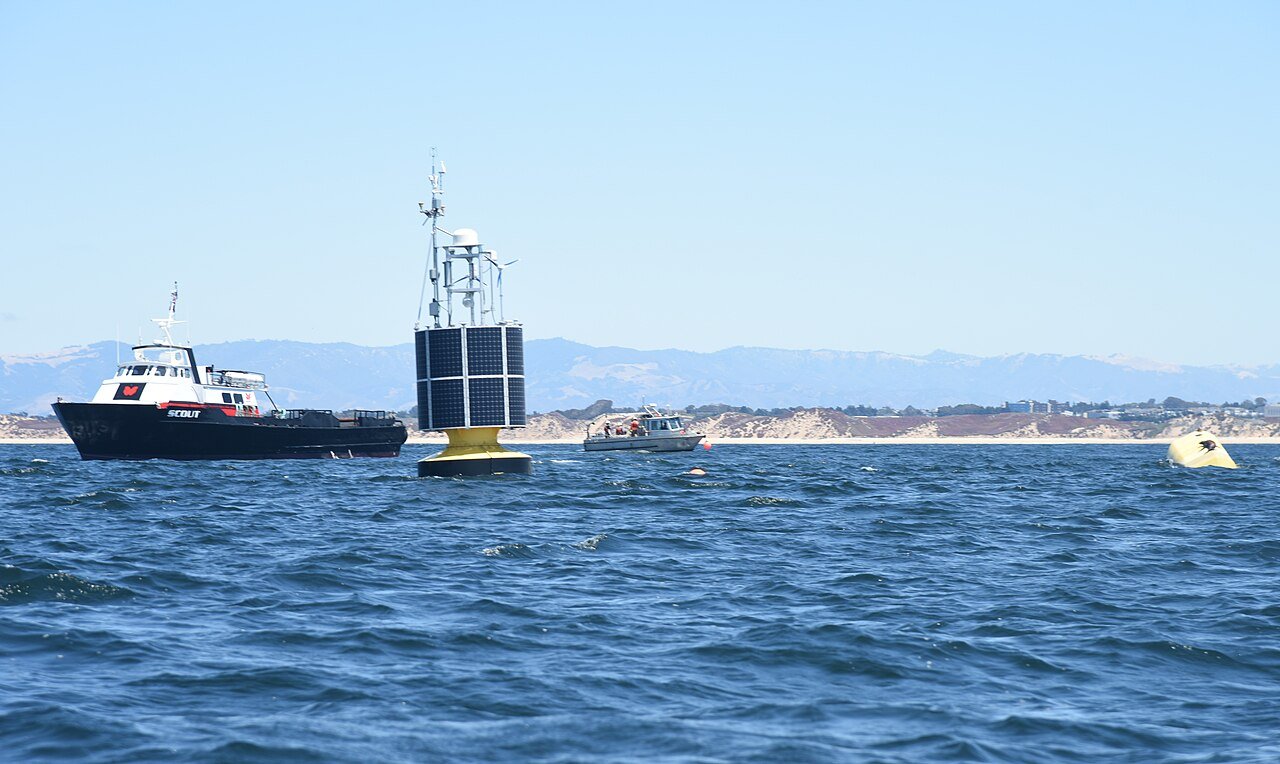
Across the South China Sea, the East China Sea, and the Yellow Sea, China has deployed a dense network of buoys ranging from basic navigational markers to sophisticated oceanographic platforms measuring up to fifteen meters in width. These have appeared near contested features such as Whitsun Reef and Scarborough Shoal, within the Korea–China Provisional Measures Zone, and even in the wider Pacific.
Formally civilian, such platforms can collect hydrographic, acoustic, and meteorological data — information of clear military value for submarine operations and anti-access strategies. Crucially, they operate within legal grey zones. Marine scientific research in Exclusive Economic Zones (EEZs) is permitted under international law, subject to consent requirements that are often ambiguously interpreted or politically contested.
This ambiguity creates what might be termed “legal saturation.” Coastal states face a dilemma: tolerate the presence and risk normalization, or intervene and risk escalation, economic retaliation, or information warfare campaigns.
Underwater and Surface Drones: Persistence Without Attribution
Chinese “Sea Wing” (Haiyi) gliders have been recovered in Southeast Asian waters since 2016. Larger unmanned underwater vehicles (UUVs) such as the HSU-001 and emerging extra-large UUV models expand endurance and payload capacity. Surface drones add another layer of presence.
These systems are not primarily designed for spectacular battlefield use. Their value lies in persistence. They can remain at sea for extended periods, gather acoustic signatures, map seabeds, monitor maritime traffic, and potentially interfere with undersea infrastructure.
The reported development of compact drones capable of targeting subsea cables illustrates the strategic messaging embedded in these systems. Critical infrastructure — energy pipelines, data cables, and sensor networks — becomes part of the competitive maritime space.
For regional navies, the challenge is doctrinal as much as technological. How should rules of engagement apply to unmanned systems operating ambiguously in EEZs? What constitutes hostile intent? At what point does interference justify countermeasures?
Floating Platforms and Modular Landing Systems
China’s innovation extends beyond drones. Since 2013, Beijing has deployed offshore platforms in the East China Sea near disputed zones with Japan, attempted hydrocarbon operations in Vietnam’s EEZ, and installed large structures in the Yellow Sea. Radar-equipped stations, aquaculture megaplatforms, and electronic warfare barges blur the line between commercial and military infrastructure.
Particularly notable are giant self-elevating landing barges capable of forming temporary artificial ports measuring nearly a kilometer long. When combined with dual-use roll-on/roll-off vessels under civil-military fusion frameworks, they significantly expand amphibious logistics flexibility.
While often analyzed in the context of a potential Taiwan contingency, their broader implication is modular expeditionary capability across contested littorals.
A Strategy of Accumulation, Not Confrontation
Taken together, these developments illustrate a coherent logic: incremental accumulation of presence, data, and infrastructure across the First Island Chain. Rather than seeking decisive naval battles, China appears focused on shaping the environment of competition itself.
Autonomous and unconventional platforms generate endurance at relatively low political cost, reduce escalation risks, and complicate attribution. They expand maritime domain awareness while testing legal boundaries. They allow China to contest maritime space continuously without crossing clear thresholds of armed attack.
For Southeast Asian claimants and regional powers, the issue is not simply numerical naval balance. It is structural. Traditional fleet comparisons fail to capture the cumulative effect of persistent grey-zone instruments embedded within civilian and paramilitary ecosystems.
The Emerging Maritime Competition Model
The maritime contest unfolding in the South China Sea is increasingly defined by three interlocking variables: permanence, ambiguity, and integration. Permanence is expressed through fixed platforms and reclaimed features that extend presence and control over disputed waters. Ambiguity is reinforced by the use of civilian-flagged or unmanned systems. Integration is evident in the coordination among naval forces, coast guards, maritime militia, scientific fleets, and legal narratives.
This evolving model does not eliminate the risk of conflict, but it reduces the likelihood of conventional fleet engagements while intensifying continuous low-intensity friction.
For regional actors, the policy response cannot rely solely on shipbuilding. It requires legal preparedness, coordinated maritime domain awareness, counter–grey zone doctrine, and resilient infrastructure protection.
The contest along the First Island Chain is less about spectacular naval clashes than about sustained positional advantage. In that sense, unmanned and unconventional platforms are not peripheral innovations; they are central instruments in the evolving architecture of maritime power in the Indo-Pacific.
 Benjamin Blandin has been working as a consultant in strategy and innovation for 15 years in both industry and consulting firms. He holds an MA in strategy consulting from EM Lyon (France), an MA in Geopolitics from the French Institute of Geopolitics and graduated from the Paris Military Academy (maritime strategy program). Benjamin has earned a Ph.D. from the Paris Catholic University in geopolitics focusing on the phenomena of A2AD, hybrid warfare and grey area tactics in the South China Sea. Benjamin is an Advisory Board Member of the South China Sea NewsWire.




