By Erik Lenhart and Michael Tkacik
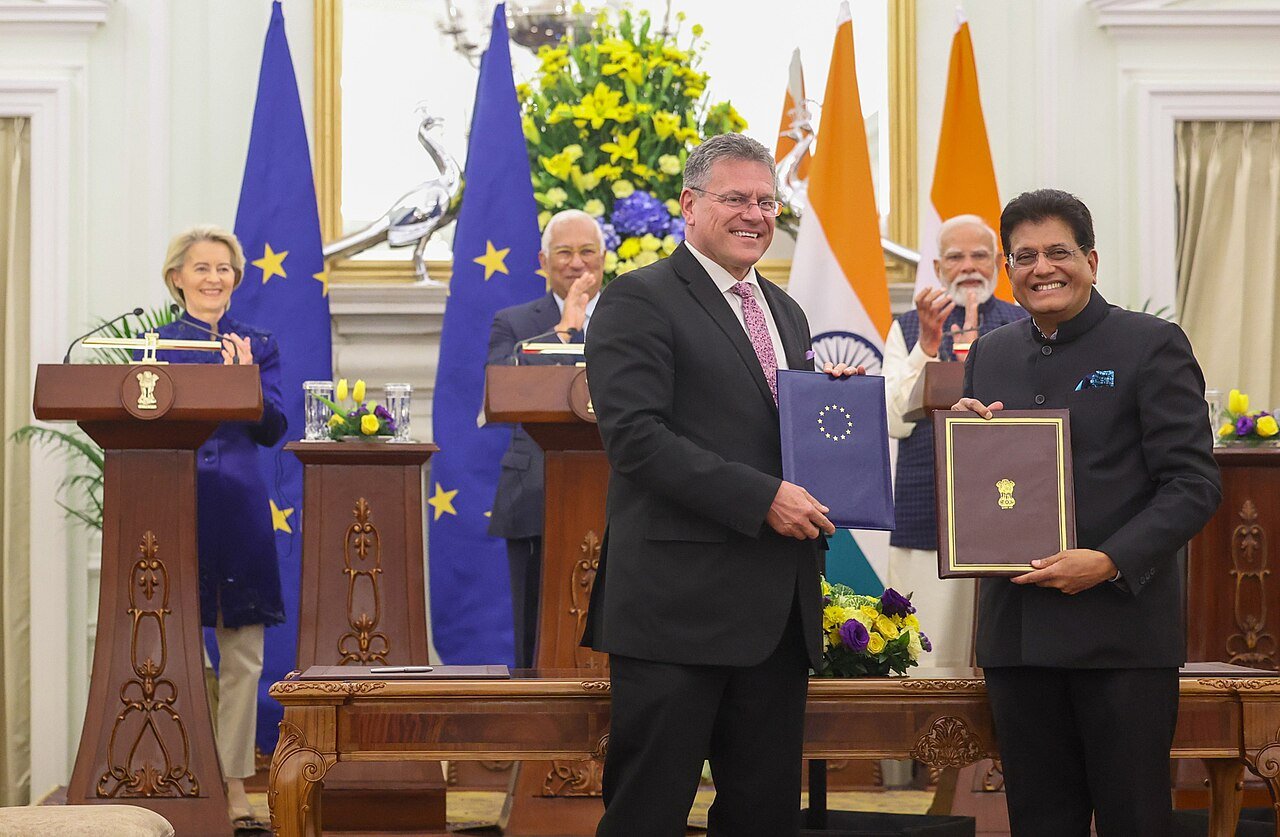
If there was any doubt that Brussels and New Delhi are entering a new era, the 16th EU–India Summit on January 27, 2026, erased it. European Council President António Costa and European Commission President Ursula von der Leyen sat down with Prime Minister Narendra Modi to unveil an agenda as sweeping as it is strategic: a long-awaited free trade agreement (FTA), a new Security and Defense Partnership (SDP), and a five-year comprehensive strategic roadmap covering everything from maritime security to high-tech innovation.
For Europe, this is more than simple market access. It is a pivot born of economic security concerns and a recognition that India is a central pillar of the future global economy. The European Commission frames the FTA as the largest either side has ever concluded. The numbers back the ambition: EU–India trade already exceeds €180 billion annually, supporting nearly 800,000 European jobs. With the new agreement, EU goods exports to India could double by 2032, saving exporters roughly €4 billion in annual tariffs.
This is not a cosmetic opening. India has committed to cutting or eliminating tariffs covering 96.6% of the value of EU goods exports—the most ambitious liberalization New Delhi has ever granted a partner. This provides privileged access for EU firms in chemicals, machinery, and medical devices, while India secures gains in labor-intensive sectors and professional mobility. It is an economic rebalancing that serves the interests of both sides.
The Security Dimension
The security deliverables are equally significant. After years of incremental maritime dialogues, the new SDP provides a formal framework to deepen cooperation on cybersecurity, counter-terrorism, and defense-industrial ties. Crucially, the two sides have also launched negotiations on a Security of Information Agreement—the “critical plumbing” necessary for real interoperability beyond mere exercises and photo-ops.
This partnership is not a turn inward. While the joint statement reiterates a commitment to the rules-based international order, it grapples with the world as it is: Russia’s war in Ukraine, turmoil in Gaza, and a more contested Indo-Pacific. Both sides pledged to support a “just and lasting peace” in Ukraine based on sovereignty and territorial integrity, even as they acknowledged areas where their assessments diverge. This realism reflects a relationship that has matured beyond rhetoric into hard-edged statecraft.
The politics of this breakthrough were impossible to miss. EU leaders served as guests of honor at India’s 77th Republic Day celebrations. This symbolism underlines how high India now ranks in Europe’s foreign policy priorities as the transatlantic center of gravity shifts.
The Washington Contrast
All of this is happening as the EU hedges against U.S. policy uncertainty. By “de-risking” from China and anchoring ties with India, Brussels is building an economic-security strategy less exposed to unilateral tariff shocks or extraterritorial demands.
This summit forces an uncomfortable comparison: while EU–India relations are on the rise, U.S.–India ties are fraying. Despite the much-celebrated rapport between Donald Trump and Narendra Modi in the late 2010s, the current atmosphere has soured. The second Trump administration’s tariff salvos, public browbeating over New Delhi’s Russian oil purchases, and episodic gestures toward Pakistan have put a quarter-century of progress at risk.
In response, New Delhi is doing what it does best: hedging. It is warming to Moscow where necessary and keeping pragmatic channels open with Beijing. While defense cooperation with the United States remains deep, the cost of neglect is mounting. When Washington hits Indian exports with 50% tariffs, it doesn’t just create leverage; it pushes India to double down on economic diversification away from the American market. The contradiction between “America First” and “Make in India” is no longer an abstract debate; it is a daily hurdle for global boardrooms.
A Lesson in Pragmatism
Europe, to its credit, read the moment and moved. The Commission sent a strong signal by making India a top-tier partner early in its mandate and following through with a comprehensive FTA/SDP package. The messaging is consistent: economic security means diversified interdependence, not autarky, and in a fractured world, “like-minded” does not have to mean “identical” on every file.
For Washington, the lesson is not to panic, but to compete. That starts with de-escalating the tariff war and ring-fencing critical-tech cooperation from protectionist swings. It means putting a realistic, narrow trade package back on the table that addresses mobility and supply-chain security without trying to litigate every difference.
It begins with accepting India’s strategic autonomy on its own terms. On Russia, Washington should stop asking New Delhi to be something it is not. Instead, the United States must make its own offer—on energy, defense co-production, and manufacturing—too attractive to turn down. The EU–India summit shows what is possible when ambition meets pragmatism. If Washington wants to remain a serious partner, it must match that focus with policy discipline rather than performative friendship.
 Erik Lenhart (erik.lenhart1@gmail.com) holds an MA in political science from Charles University. He is a former Deputy Chief of Mission of the Slovak Republic in Tokyo and the author of the award-winning novel Daughters of the Empire.
Michael Tkacik (mtkacik@sfasu.edu) holds a PhD from the University of Maryland and a JD from Duke University. He is a professor of government and director of the School of Honors at Stephen F. Austin State University in Texas.
Image Credit: This file is a copyrighted work of the Government of India, licensed under the Government Open Data License – India (GODL) permitting worldwide, royalty-free, and non-exclusive license to use. Source link: File:The India–European Union Free Trade Agreement.jpg – Wikimedia Commons




