
By Erik Lenhart and Michael Tkacik
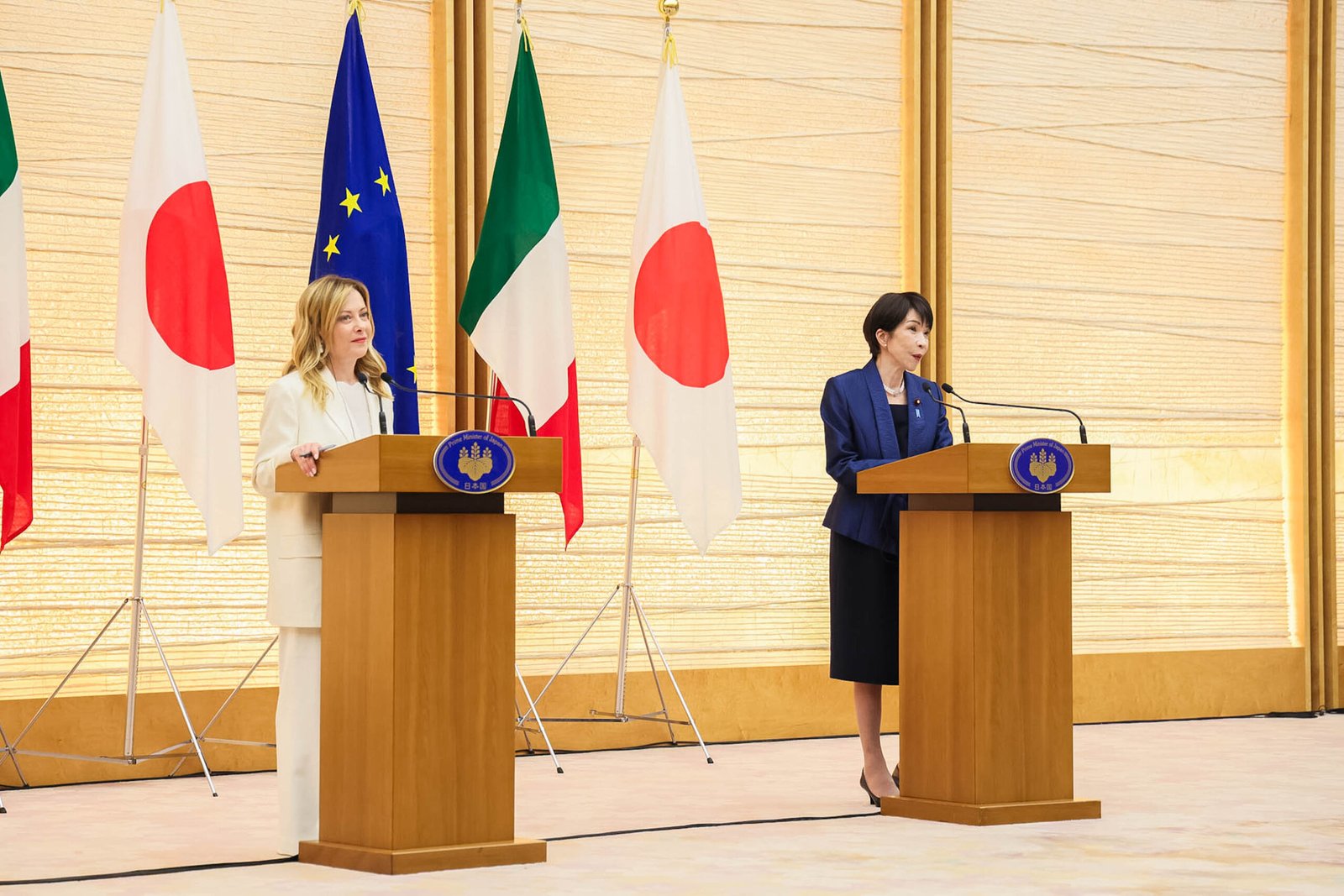
Prime Minister Sanae Takaichi’s summit with Italian Prime Minister Giorgia Meloni in Tokyo on January 16 stands out as a defining moment in G7 diplomacy. Marking the 160th anniversary of diplomatic relations, the meeting moved beyond traditional protocol to establish a Special Strategic Partnership. The atmosphere was notably personal: Takaichi presented a cake for Meloni’s 49th birthday, and the two leaders—the first women to lead their respective nations—addressed each other as “Sanae” and “Giorgia.” This rapport underscores a deep alignment on security, energy, and economic resilience.
Pragmatism Over Ideology
Takaichi and Meloni embody a governance style that prioritizes national interest over rigid doctrine. Both have pivoted from early conservative reputations toward pragmatism focused on tangible outcomes in a volatile global landscape. This shift has allowed them to navigate complex relationships with the Trump administration with remarkable agility.
During the U.S. President’s October 2025 visit to Tokyo—where the two declared a “New Golden Age”—Takaichi secured a 15% cap on reciprocal tariffs and reaffirmed a $550 billion Japanese investment framework into U.S. industry. Her upcoming March 2026 visit to Washington is expected to cement this alignment, focusing on a unified stance on regional stability ahead of the Trump-Xi summit in April.
Meloni employs a similar high-wire strategy. By leveraging shared rhetoric on national sovereignty while securing tangible wins—such as the recent reduction of U.S. tariffs on Italian exports—she has positioned herself as a vital bridge between Washington and a wary Brussels. Like Takaichi, who used her “drumming diplomacy” in Nara with South Korean President Lee Jae Myung last week to stabilize regional ties, Meloni uses high-trust personal connections to ensure Rome remains an indispensable partner in both the Atlantic and the Pacific.
Strategic Deliverables: Defense, Minerals, and LNG
The summit yielded concrete commitments designed to mitigate asymmetric dependencies. Central to this is the Global Combat Air Programme (GCAP), a trilateral initiative with the United Kingdom to develop a sixth-generation fighter by 2035. With the Japan-Italy Acquisition and Cross-Servicing Agreement (ACSA) having taken effect in late 2025, the Italian and Japanese militaries are now better positioned for mutual logistics and joint naval exercises.
Economic security was equally prominent. Following recent disruptions in critical mineral supplies—linked to the regional fallout from Takaichi’s firm stance on Taiwan last autumn—both leaders stressed the “urgent task” of diversifying supply chains to insulate industrial systems from external market distortions.
Energy resilience provided a practical breakthrough through a new agreement with the Italian energy giant Eni S.p.A. The firm will act as an emergency LNG supplier to Japan, while Japanese financial institutions back Eni’s natural gas development in Mozambique. This partnership allows Tokyo to diversify procurement beyond traditional sources in Australia, Malaysia, and the United States. In addition, this diversification may facilitate a strategic reduction in reliance on Russian energy—specifically the Sakhalin II project—amid mounting G7 pressure for a total ban on Russian exports.
A Geopolitical Signal: Converging Frontiers
The Tokyo summit signals a deeper structural shift: the convergence of European and Indo-Pacific security. In their Joint Statement, the leaders reaffirmed that the security of the Euro-Atlantic and Indo-Pacific is now “interrelated.” By linking the “Free and Open Indo-Pacific” (FOIP) with the “Global Mediterranean,” Rome and Tokyo are bridging two vital maritime regions. Italy’s 2023 departure from the Belt and Road Initiative—driven by unfulfilled economic promises and a ballooning trade deficit—marked a definitive pivot toward the reciprocal partnerships Japan has long championed.
This cooperation extends to the final frontiers of technology and space. The leaders announced a new consultative framework for space cooperation, targeting joint satellite development and debris mitigation. Combined with Italy’s participation in Yokohama’s GREEN×EXPO 2027 and Japan’s support for the Milano Cortina 2026 Winter Olympic and Paralympic Games, the partnership transforms Japan–Italy ties from cordial to strategically essential. In an environment marked by the weaponization of supply chains, Takaichi and Meloni have opted for a path of mutual reliance—a clear message that practical alignment and integrated security are the most effective responses to external pressure.
 Erik Lenhart (erik.lenhart1@gmail.com) holds an MA in political science from Charles University. He is a former Deputy Chief of Mission of the Slovak Republic in Tokyo and the author of the award-winning novel Daughters of the Empire.
Michael Tkacik (mtkacik@sfasu.edu) holds a PhD from the University of Maryland and a JD from Duke University. He is a professor of government and director of the School of Honors at Stephen F. Austin State University in Texas.




