
By Erik Lenhart and Michael Tkacik
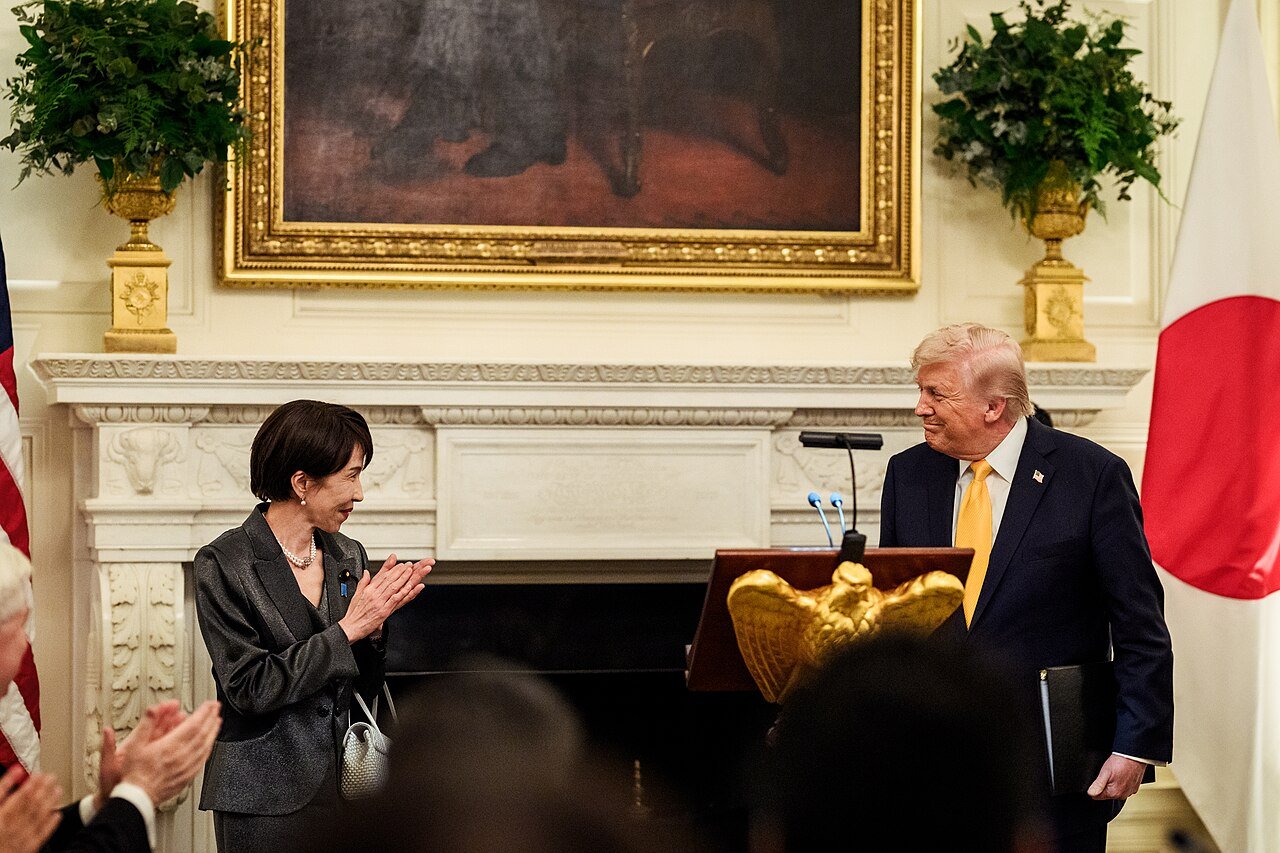
The second Takaichi–Trump summit in Washington represented a shift away from the era of sweeping rhetoric and grand communiqués toward a more pragmatic “functionalism under pressure”. Rather than focusing on stylistic flourishes, the meeting produced a bundle of concrete deliverables designed to anchor the U.S.–Japan alliance in industrial capacity, energy security, and critical minerals at a time when global supply chains are under intense strain.
The Hormuz Crisis: Setting the Diplomatic Floor
The summit took place against the backdrop of an escalating crisis in the Middle East. On March 19, 2026, just prior to the Washington meeting, Japan joined the United Kingdom, France, Germany, Italy, and the Netherlands in a joint statement condemning Iranian attacks on shipping and civilian infrastructure. Led by Britain, this “G7-core” group signaled a readiness to contribute to safe passage in the Strait of Hormuz while backing an International Energy Agency (IEA) strategic release of oil stockpiles to stabilize markets.
This multilateral move served two purposes: it demonstrated a shared sense of crisis among key allies and provided a foundational layer of coordination before Prime Minister Sanae Takaichi met with President Trump. It also signaled Tokyo’s intent to support U.S. calls for cooperation while navigating its own complex domestic constraints.
Threading the Needle: Japan’s Legal Guardrails
Prime Minister Takaichi arrived in Washington hoping to de-escalate the Middle East crisis but equally committed to explaining the specific boundaries of Japanese law to President Trump. This “needle-threading” diplomacy is rooted in the actual legal architecture of postwar Japan rather than mere political hedging.
Under Article 9 and 2015 security legislation, Tokyo utilizes the following three primary levers. The first, maritime security operations, would involve the Maritime Self-Defense Force (MSDF) being deployed as a “police-power” mission to protect Japan-related shipping. Next, collective self-defense by escorting non-Japanese vessels or using force would require designating a “survival-threatening situation”. This is a high threshold that successive governments have never crossed. Finally, domestic resilience, where Japan has focused on what it can do rapidly, such as the drawdown of private-sector oil stocks—backed by statutory mandates—to cushion the domestic economy from disruptions in the Strait of Hormuz.
Industrial Policy with Teeth: Energy and Minerals
The summit’s most tangible results appeared in the Japan–U.S. Strategic Investment package, which moved into its second tranche with up to $73 billion in U.S.-based energy projects. Roughly $40 billion was allocated for advanced small modular reactors (SMRs) in Tennessee and Alabama. Additionally, investments for natural gas generation earmarked $17 billion for Pennsylvania and $16 billion for Texas.
These investments are specifically aimed at hardening the American power grid—particularly in data-center-heavy regions—while deepening the footprint of Japanese capital in U.S. reindustrialization.
Beyond energy, the two leaders unveiled an Action Plan for Critical Minerals Supply Chain Resilience. This plan moves beyond vague frameworks by committing to coordinated trade tools, including border-adjusted price floors. This is industrial policy aimed at de-risking from non-market suppliers by stabilizing markets for strategic minerals. Specific ventures were cataloged in a Joint Fact Sheet, ranging from rare-earth recycling in Indiana to lithium opportunities in North Carolina and copper projects in Arizona.
Furthermore, a new Memorandum of Cooperation (MOC) on Deep-Sea Mineral Resource Development was signed. This creates a working group to accelerate the commercialization of seabed resources, including Japan’s pathbreaking rare-earth muds near Minami-Torishima, aligning these efforts with U.S. regulatory streamlining.
A Wider Lattice of Partnerships
Takaichi’s success in Washington was bolstered by her prior diplomatic efforts to build a “wider lattice” of like-minded partners. In early March, she elevated ties with Canada to a “Comprehensive Strategic Partnership” and, in January, held a high-level summit with the United Kingdom’s prime minister that launched the Japan-UK Strategic Cyber Partnership to strengthen cyber resilience and deter emerging threats. These steps deliberately wove Atlantic and Indo-Pacific democracies together around economic and security resilience — strengthening her position on the Hormuz crisis.
Takaichi’s Success in 2026
The Takaichi–Trump meeting avoided public rifts over naval deployments, choosing instead to focus on “deterrence by resilience.” By linking energy security in the Middle East to industrial capacity in the Indo-Pacific, the summit recognized that modern alliances must show the public tangible benefits when foreign crises drive up domestic prices.
 Erik Lenhart (erik.lenhart1@gmail.com) holds an MA in political science from Charles University. He is a former Deputy Chief of Mission of the Slovak Republic in Tokyo and the author of the award-winning novel Daughters of the Empire.
Michael Tkacik (mtkacik@sfasu.edu) holds a PhD from the University of Maryland and a JD from Duke University. He is a professor of government and director of the School of Honors at Stephen F. Austin State University in Texas.




