
By Lilou Blengini
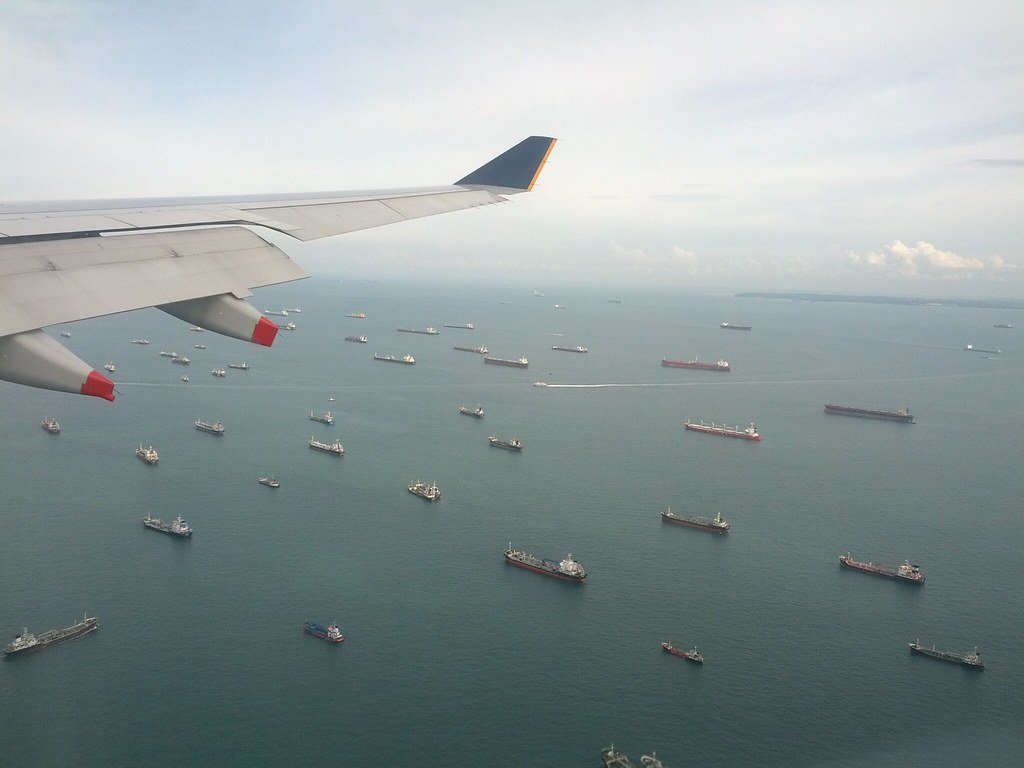
The Strait of Malacca is more than a shipping lane. It is a strategic artery for the Indo- Pacific—and one of the region’s most consequential chokepoints. Stretching only 900 kilometers between Indonesia, Malaysia, and Singapore, the Strait provides the shortest maritime route linking the Middle East and Europe with the major economies of East Asia. More than 102,500 vessels transited its narrow waters in 2025, while about 30 submarine fiber-optic cables beneath the seabed carry another vital commodity: information.
Indonesia, Malaysia and Singapore jointly manage the Strait, while its legal regime is governed by the United Nations Convention on the Law of the Sea (UNCLOS), which guarantees the right of transit passage. The littoral states therefore cannot suspend navigation, arbitrarily restrict access, or impose tolls on foreign vessels. This makes a deliberate blockade relatively unlikely outside a major regional conflict. Nevertheless, the Strait remains vulnerable because of its geography and high traffic density. In areas such as the Phillips Channel, its width falls below 3 km, increasing the risk of congestion and maritime accidents, while piracy remains an additional security concern.
The Strait is particularly significant for China, as an estimated 60–80% of its energy imports transit through it. Former Chinese President Hu Jintao referred to this dependence as the “Malacca Dilemma”, reflecting Beijing’s vulnerability to disruptions along a route it does not directly control. This vulnerability extends beyond energy security to the logistical and digital infrastructure on which the Chinese economy depends. The Strait thus constitutes a strategic space where commercial, energy, technological, digital, and military interests intersect.
This dependence is further embedded in the broader US–China strategic rivalry. The United States maintains a significant military presence across the Indo-Pacific and has security partnerships with the three states controlling access to the Strait. In addition to longstanding defense arrangements with Singapore, Washington strengthened its security cooperation with Malaysia in 2025 and deepened its strategic partnership with Indonesia. While the U.S. does not directly control the Strait, these partnerships give Washington considerable influence over its strategic environment. The Strait is therefore a key strategic chokepoint in the balance of power between China and the U.S.
Recent developments surrounding other maritime chokepoints have further highlighted these vulnerabilities. The blockade of the Strait of Hormuz amid the war in Iran has renewed concerns over the use of chokepoints as instruments of coercion. Tehran’s attempts to control and impose costs on maritime traffic have demonstrated how control over a strategic waterway can enhance a state’s bargaining power. This raises concerns about the potential militarisation of other chokepoints, including the Strait of Malacca, particularly given its proximity to the South China Sea and the Strait of Taiwan, two critical waterways connecting major economic centres. For China, such developments reinforce the need to diversify its trade and energy.
A second emerging concern is the potential monetisation of the Strait by its littoral states. Indonesian Finance Minister Sadewa recently raised the possibility of introducing a transit toll for vessels using the Strait, with revenues shared between Indonesia, Malaysia and Singapore. The proposal has reportedly generated questions from the other littoral states as well as Australia and could generate protests from the U.S. and China if it were to happen. Such a measure could also raise legal concerns, as it may conflict with the transit passage regime established under UNCLOS.
To reduce its vulnerability, Beijing is pursuing two main strategies. First, it is strengthening its maritime presence across the Indo-Pacific, particularly in the South China Sea, to protect its sea lines of communication and critical trade and energy routes. Second, it is developing alternative land-based routes through the Belt and Road Initiative, notably the China–Myanmar Economic Corridor and the China–Pakistan Economic Corridor. These corridors provide additional routes that partially bypass the Strait and reduce China’s exposure to maritime disruptions.
However, these alternatives remain constrained by limited capacity and significant political and security risks. Myanmar and Pakistan both face persistent instability, and their land corridors cannot match the scale and efficiency of maritime trade through the Strait. They can therefore diversify China’s supply chains and mitigate its vulnerability but cannot replace the Strait of Malacca in the medium term. Beijing’s strategy is consequently one of risk reduction rather than complete strategic independence.
The Strait of Malacca will remain a systemic vulnerability with economics, technological, legal, and military implications for the region and global supply chains. Managing this risk, especially as trade and the development of undersea cables expands, requires a multi-dimensional response, strengthening freedom of navigation under UNCLOS, and deepening multilateral cooperation on maritime security to reduce coercion.
Lilou Blengini is a French graduate in International Relations, specializing in Peace, Security and Conflicts. She is currently pursuing a specialization in European Affairs at the Université Libre de Bruxelles, with a strong interest in defense, security and the Asia-Pacific region.
Linkedln: https://www.linkedin.com/in/lilou-blengini-167b17331/fr




