
By Bálint Jurászik
The South China Sea may lie hundreds of miles from South Korea’s shores, but the contested waterway is central to the country’s economic security, carrying maritime trade from Busan, one of the world’s busiest container ports, that connects its industrial heartland with Southeast Asia, the Indian Ocean, and Europe.
The port’s transformation from a Korean War refuge into an international shipping powerhouse reflects South Korea’s remarkable economic ascent. Yet its prosperity increasingly depends on the stability of maritime routes over which Seoul exercises little control. According to the Korea Institute for Maritime Strategy, approximately 64 percent of South Korea’s oil imports and 46 percent of its natural gas imports depend on shipping routes through the South China Sea.
These figures highlight the country’s vulnerability to disruptions in maritime trade, particularly given its heavy dependence on imported energy. Even a temporary interruption could increase transportation costs, strain industrial supply chains, and threaten the competitiveness of South Korea’s export-oriented economy. The strategic importance of Busan extends beyond its commercial operations. In July 2025, Song Sang-keun, President of the Busan Port Authority, described the port as “a core foundation of the national economy and a security hub.” Although his remarks concerned the protection of port infrastructure, they also underscore the broader relationship between maritime security and South Korea’s economic resilience.
From Export Port to Global Hub
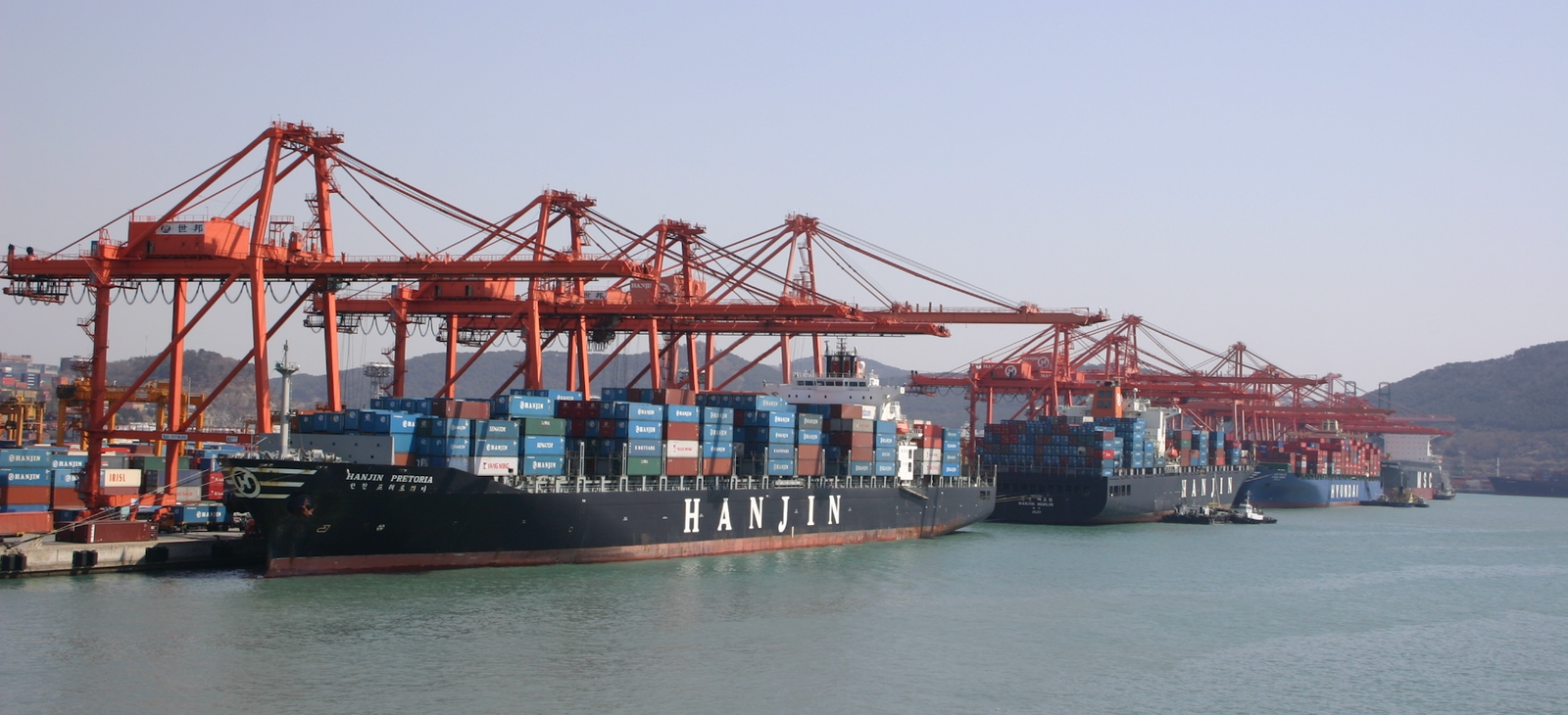
After the war, South Korea built its economy on exports, so efficient access to overseas markets became vital. A series of major infrastructure projects gradually transformed the old port. According to the Busan Port Authority’s history of the port, development between 1974 and 1982 included four container piers, and later projects added the Sinseondae and Gamman container terminals. A decisive milestone came in September 1978, when the Jaseongdae Container Terminal began operations as South Korea’s first dedicated container terminal. Its development marked a major step in Busan’s transformation into a modern maritime logistics hub. The terminal eventually expanded to cover approximately 624,000 square metres, with 1,447 metres of quay and an annual handling capacity of 1.72 million twenty-foot equivalent units (TEUs). Its facilities could accommodate four 50,000-deadweight-tonne vessels simultaneously, illustrating the scale of the infrastructure developed to support South Korea’s rapidly expanding international trade. Containerization helped turn Busan from a conventional cargo port into a modern logistics center that could handle the rapid growth of Korean trade. Busan New Port, which began operating in the 2000s, later moved much of the city’s container activity to larger, more advanced facilities.
Busan’s importance as a global shipping hub rests largely on its role as a transshipment center, where cargo is transferred between vessels bound for destinations across Asia. Busan Port Authority statistics show that the port handled 24.4 million twenty-foot equivalent units (TEUs) in 2024, including almost 13.5 million TEUs of transshipment cargo. In other words, more than half of Busan’s container traffic was cargo moving between ships, not entering or leaving the Korean market. That makes the port an intermediary between regional and global shipping networks. The port authority describes Busan as connected with around 500 ports in 100 countries, while its promotional material calls it the world’s second-largest transshipment port and seventh-largest container port. This extensive connectivity has made Busan indispensable to regional shipping networks. As Tan Hua Joo, a shipping analyst at Linerlytica, explained to The Loadstar, “Busan is the largest transshipment hub in North Asia and offers the widest selection of network connections for the region.” His assessment highlights why Busan serves not merely as South Korea’s principal maritime gateway, but also as a critical transfer point for international cargo moving between Northeast Asia and the wider world.
Busan Looks South
South Korean companies have moved production into Southeast Asia, and Busan’s shipping network has followed. Korean firms now run factories across the Association of Southeast Asian Nations (ASEAN), so production splits between Korea and plants elsewhere in Asia. The ASEAN-Korea Centre describes a regional supply chain in which raw materials flow from across Southeast Asia to South Korea, where manufacturers transform them into industrial components before shipping them back to ASEAN countries for final assembly.
This growing economic interdependence has transformed Southeast Asia from a market for South Korean exports into an integral part of the country’s manufacturing system. Among ASEAN economies, Vietnam has emerged as a particularly important production base, illustrating how Korean industrial investment, cross-border supply chains and maritime trade have become increasingly interconnected.
World Bank trade data show that Vietnam was among South Korea’s five largest export markets for intermediate goods in 2023. More recent Korean trade data underline the scale of this relationship. In 2024, semiconductors alone accounted for more than $18 billion of South Korean exports to Vietnam, alongside displays, sensors, synthetic resins and other industrial inputs. KOTRA linked this growth to expanding production at Korean manufacturing bases in Vietnam.
Busan provides the shipping infrastructure that connects this widely spread Korean production system to international trade. The relationship does not run between one Korean port and one Southeast Asian destination. It is a network of ports, factories, feeder services and long-distance shipping routes linking Northeast and Southeast Asia.
The South China Sea is central to that geography. Ships carrying goods between Korea and Southeast Asian manufacturing centers, then continuing toward the Strait of Malacca, enter a corridor that also links East Asia with the Indian Ocean, the Middle East and Europe. Busan’s success as a transshipment hub therefore depends on connections far beyond the Korean Peninsula.
More Than Containers
Busan’s Southeast Asian ties are also diplomatic. The city hosted the ASEAN-Republic of Korea Commemorative Summit in 2014 and again hosted ASEAN leaders in 2019. The latter gathering marked 30 years of ASEAN-South Korea dialogue relations, and ASEAN’s official summit statement confirms that it took place in Busan on November 26, 2019. Busan also hosted the first Mekong-Republic of Korea Summit that year.
These meetings left a lasting mark. The ASEAN Culture House opened in Busan in September 2017 as a direct follow-up to the 2014 summit. Operated by the Korea Foundation, it promotes cultural and academic networks between Korea and Southeast Asia and gives ASEAN a permanent public-diplomacy presence in the city.
Busan’s transformational story therefore reflects a broader regional pattern.
During the Korean War, access to the sea helped keep South Korea connected to the outside world. During industrialization, the port connected Korean factories to global markets. Today, Busan links a much more geographically dispersed Korean economy to regional and global maritime networks. The city may face the Pacific, but an important part of the economic network sustaining its role as a global maritime hub runs south, toward Southeast Asia and through the South China Sea.
Bálint Jurászik is a Research Associate — Editorial Contributor at the South China Sea NewsWire. He is also a Hungarian historian and researcher specializing in modern history and East and Southeast Asian international relations. He is currently completing his MA in History at Kodolányi János University. His research interests include modern Korean history, democratization and social movements, Southeast Asian regional politics, Indonesian foreign policy, and the social history of the Cold War. His work combines historical research with an interest in contemporary regional affairs and international cooperation in East and Southeast Asia.




