
By Dumitru Palanciuc
Cambodia’s growing ties with Washington could reshape democratic alignments in the South China Sea, where Phnom Penh has long been regarded as one of Beijing’s closest allies within the Association of Southeast Asian Nations (ASEAN).
Following its 2025 border conflict with Thailand, Phnom Penh has moved to strengthen relations with the United States, raising questions about whether its diplomatic shift could influence ASEAN’s approach to China’s territorial claims and maritime ambitions.
Prime Minister Hun Manet has sought to balance those competing interests. Responding to criticism of Cambodia’s close ties with Beijing, he said in 2025 that his country wanted both “cabbage and beef,” a reference to the economic and political benefits of maintaining strong relations with China and the United States.
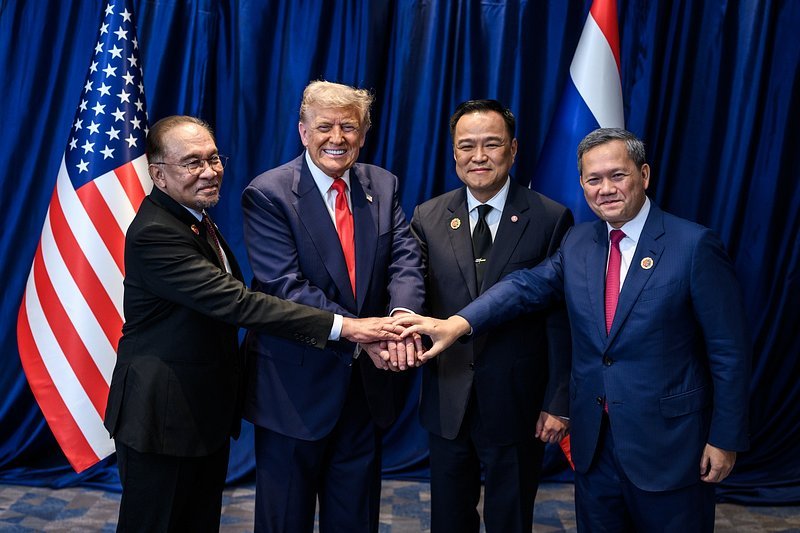
Following a U.S.-brokered ceasefire with Thailand, Phnom Penh joined President Donald Trump’s Board of Peace, secured a reduction in U.S. tariffs from 49% to 19%, and announced plans to resume Angkor Sentinel, a joint military exercise involving Cambodian and American forces.
These developments illustrate how smaller countries can navigate competition between major powers. Rather than choosing between Beijing and Washington, Cambodia is engaging with both to protect its political interests, support economic growth, and strengthen its international standing.
From “evil” China to an “ironclad” partnership with Beijing, Cambodia has been governed by the Cambodian People’s Party (formerly Kampuchean People’s Revolutionary Party) since 1979. Between 1993 and 2023, the country was under the de facto leadership of Hun Sen, who served as Prime Minister. He was succeeded by his son Hun Manet; Hun Sen subsequently became President of the Senate in 2024.
In the late 1980s, Hun Sen wrote an essay in which he called China “the root of all that is evil in Cambodia.” The harsh language was motivated by Beijing’s sponsorship of the Khmer Rouge and invasion of northern Vietnam in 1979.
During the 1990s, Hun Sen gradually improved relations with Beijing, eventually making Cambodia one of China’s closest partners in Southeast Asia. Almost four decades after his essay, Hun Sen declared that the ties between Cambodia and China were “ironclad”.
Indeed, China has become Cambodia’s largest overall trading partner, with over $15 billion in bilateral trade in 2024. The trade is heavily skewed towards Chinese imports, with Cambodian exports totaling just $1.75 billion. China is also the dominant investor. Its foreign direct investment (FDI) reached nearly $3.4 billion in 2024, or up to 75% of total FDI inflows into Cambodia.
The Cambodia-China Free Trade Agreement, signed in 2020 and implemented in 2022, further deepened economic ties. Xi Jinping’s state visit in April 2025 further strengthened bilateral cooperation. It produced 37 agreements on trade, infrastructure, education, health, and defense. The Chinese-funded reconstruction of the Ream Naval Base, inaugurated in the same month, is the most sensitive symbol of the closeness between the two countries.
Recalibration toward Washington
The U.S. is Cambodia’s largest market, with exports to the U.S. making up 43.5% of Cambodia’s total exports (valued at over $9 billion in the first seven months of 2026). The garment, footwear, and travel goods sector employs nearly a million workers, mostly women, whose wages sustain households across the country. Tariff escalation would have directly threatened social stability and regime legitimacy, so Phnom Penh has moved to reopen security and economic channels with Washington.
The 2025 Cambodian-Thai border conflict and the ceasefire brokered by Donald Trump played an even bigger role in the revitalization of this relationship. In October 2025, the two countries announced the resumption of the Angkor Sentinel, last held in 2017. The U.S. lifted its four-year arms embargo a month later. In January 2026, USS Cincinnati made a five-day stop at the Ream Naval Base, which was reconstructed with Chinese funding.
To show that relations with China and the U.S. are not mutually exclusive, Hun Manet signed the Agreement on Reciprocal Trade and joined the Board of Peace, both initiated by Donald Trump. These decisions also suggest that Phnom Penh does not view closer relations with Washington as incompatible with its partnership with Beijing.
Hun Manet’s education at West Point and New York University may also help explain his familiarity with the United States. However, the extent to which this background influences his foreign policy remains unclear, especially if the U.S. does not put as much emphasis on human rights violations and political liberty at home.
Cambodia as an example of small-state agency
Cambodia’s strategy of engaging with both powers reflects its efforts to protect political stability, support economic growth, and strengthen its international standing. Phnom Penh accepted funding from China to expand Ream but did not offer exclusive basing rights. It welcomed the renewal of exercises with the U.S. but avoided a formal alliance.
Cambodia depends heavily on imports from China and exports to the United States. Losing access to either market would carry significant economic costs. So, Phnom Penh signed a free trade agreement with Beijing, a reciprocal trade agreement with Washington, and is courting South Korea, Japan, Regional Comprehensive Economic Partnership (RCEP) members, and the Association of Southeast Asian Nations (ASEAN) to diversify further.
This agency has its limits. The two relationships are not equal: China remains fundamental to Cambodia. The strategy also relies on the U.S. overlooking human rights and political freedoms. But this balance can exist for a period.
Beijing’s neutrality in the Thai border conflict showed that the ironclad partner may not show up in a crisis. Beijing’s restraint did not necessarily signal a weakening of its commitment to Cambodia, but it underscored the risks of relying too heavily on any single major power during a regional crisis. Cambodia ‘s response illustrates how small countries can navigate great power competition without becoming pawns in a contest between Washington and Beijing. By strengthening ties with the United States while preserving its longstanding relationship with China, Phnom Penh is seeking to expand its diplomatic options, attract investment and reinforce its strategic independence. The symbolism is striking. Cambodia can name a boulevard after Xi Jinping, while simultaneously welcoming renewed American military cooperation and deeper economic cooperation.
Far from being contradictory, these gestures reflect a calculated effort to maintain productive relationships with competing powers without surrendering the freedom to pursue its own interests.
Dumitru Palanciuc is a Research Associate — Editorial Contributor at the South China Sea NewsWire. He holds a Master of Law in China Studies from Renmin University of China. His research interests include China’s engagement with smaller states, Chinese foreign policy, international relations, economic statecraft, and strategic competition.




