
By Yilun Zhang
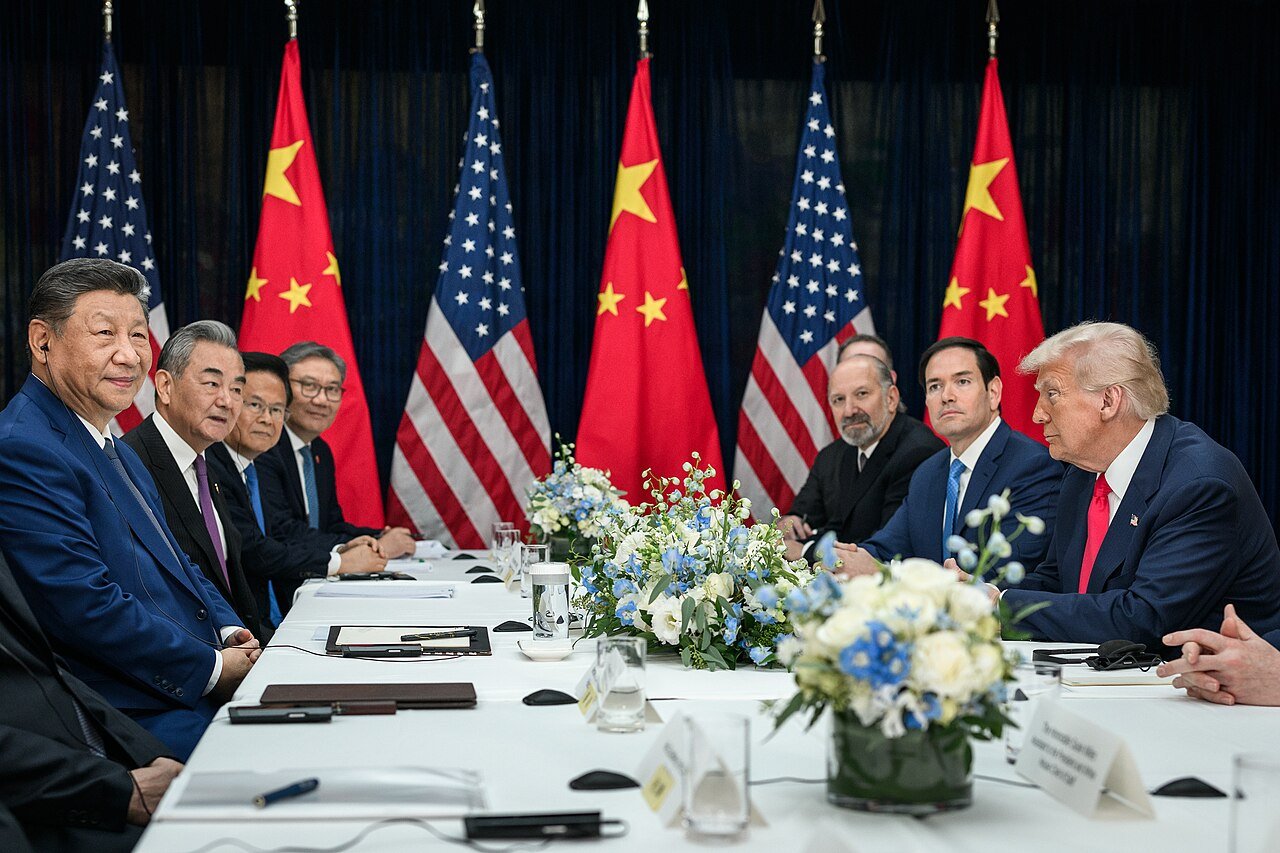
The meeting between President Xi Jinping and President Donald Trump in Busan, South Korea, offered a welcome pause to the friction that has defined U.S.–China relations in recent months. Against this backdrop, the Institute for China-America Studies (ICAS) convened its 2025 Annual Conference in Washington, bringing together Chinese and American experts—nearly 200 participants online and in person—to discuss the future of this critical bilateral tie.
Both leaders appeared determined to avoid further deterioration and to project a sense of stability to their domestic audiences, particularly for President Trump who claimed to finally strike a mega deal with China. Following the meeting, the Trump administration triumphantly described what it framed as a huge achievement safeguarding U.S. national security: China would resume purchases of American soybeans, the two sides would mutually suspend port fees, and Washington would delay its 50% entity list rules in exchange for Beijing’s one-year delay on some rare earths export restrictions, alongside a partial rollback of the other tariffs. Yet the irony was hard to miss—virtually every trigger of this latest round of economic tension, from fentanyl tariffs to port fees and entity-list bans, had been unilaterally imposed by Washington in the first place. The White House was, in effect, celebrating its own reversal.
Nevertheless, for the first time in months, Washington and Beijing were finally able to champion constructive talks and mutual respect together. Yet the very brevity of these commitments—set to expire before the 2026 midterm elections—reminds observers how fragile this stability remains.
Trump’s transactional instincts continue to shape America’s approach to China. His administration’s foreign economic policy is driven less by strategic coherence than by the search for political and mercantile wins. As Minister Qiu Wenxing, Deputy Chief of Mission at the Chinese Embassy in the USA, observed at the ICAS 2025 Annual Conference, the Busan meeting was “guardedly positive,” but a stable relationship requires more than episodic dialogue—it demands mutual adherence to facts and law. That spirit is rarely found in Washington’s domestic debates, where China is too often framed as a political foil rather than a strategic counterpart.
Indeed, momentum in Busan has also revealed the limits of temporary thaw sans consistent dialogue and a common vision for coexistence. The U.S. Trade Representative has reopened a new Section 301 investigation into China’s compliance with the 2020 “phase one” deal. Congressional lawmakers are pushing for tighter outbound-investment controls and stronger export restrictions on AI and semiconductors. Labor unions and lawmakers have criticized the port fee pause as a betrayal of domestic workers. Meanwhile, the TikTok divestment deal remains unfinished, and the White House continues to brandish tariffs as the handy tool of economic and diplomatic statecraft. If Busan was meant to signal a policy reset, the institutional momentum in Washington is already pulling in the opposite direction.
Nowhere is this contradiction clearer than on the question of Taiwan. President Trump suggested before the meeting that he would “raise the issue directly” with President Xi — and reportedly even shared his own talking points with the Chinese leader. Yet the joint readouts were silent on Taiwan, a silence both telling and calculated. For Beijing, the island is a domestic matter beyond bargaining; for Washington, it remains a symbolic test of deterrence that few officials actually wish to fail. As Michael Swaine has pointed out at the ICAS Annual Conference, the United States neither possesses the capacity nor the political will to intervene decisively in a Taiwan conflict—meaning that crisis management and communication mechanisms are the only plausible path to avoid miscalculation.
The larger picture is one of selective engagement within structural rivalry. Both sides seek to stabilize without conceding, to cooperate without trusting. Just when Xi meets Trump, China revealed its new Five Year Plan, signaling that it will continue its economic rebalancing and industrial upgrading despite external headwinds, while the United States struggles with deep political polarization and an eroding consensus with global trade partners. Washington does not have the luxury of a grand strategy in the classical sense; it is governed by domestic urgency. In that context, dialogue with Beijing serves as a mechanism of damage control rather than a path to resolution.
Yet even a transactional truce can be valuable. By postponing escalation, Busan has created space for policy communities in both countries to re-evaluate what stability might look like in an age of fragmentation. For President Trump, it offers a brief political breathing space to grapple with a historic government shutdown and the resurfacing of the Epstein files scandal—issues far more combustible domestically than tariffs or tech bans. For Beijing, it provides a window to formally roll out its new Five-Year Plan without the distraction of immediate external shocks. These semantic adjustments may appear minor, but they reflect a broader recognition that the two largest economies remain too interdependent to sustain permanent estrangement.
Still, good intentions have short half-lives in an American election cycle. As the 2026 midterms approach, the temptation to revive anti-China rhetoric or escalate trade and tech friction will grow. Trump may yet declare Busan a success, but the durability of that success depends on whether both capitals can translate summit optics into institutional restraint. Absent that, the U.S.–China relationship will remain a cycle of suspension and re-escalation—a pattern that exhausts diplomats and markets alike.
Yilun Zhang is a Research Associate and the manager of the Trade ’n Technology (TnT) program at the Institute for China-America Studies (ICAS). He is also the manager of the ICAS Maritime Issue Tracker Project. His research focuses on the U.S.-China strategic competition; major power relationships in the Indo-Pacific region; and U.S. Congress. He writes about a wide range of issues including supply chains, Western Pacific security, trade, technology and investment, and U.S. legislative actions and the implications for the U.S.-China bilateral relationship. He is also the Administrative Officer of ICAS.




