
By Erik Lenhart and Michael Tkacik
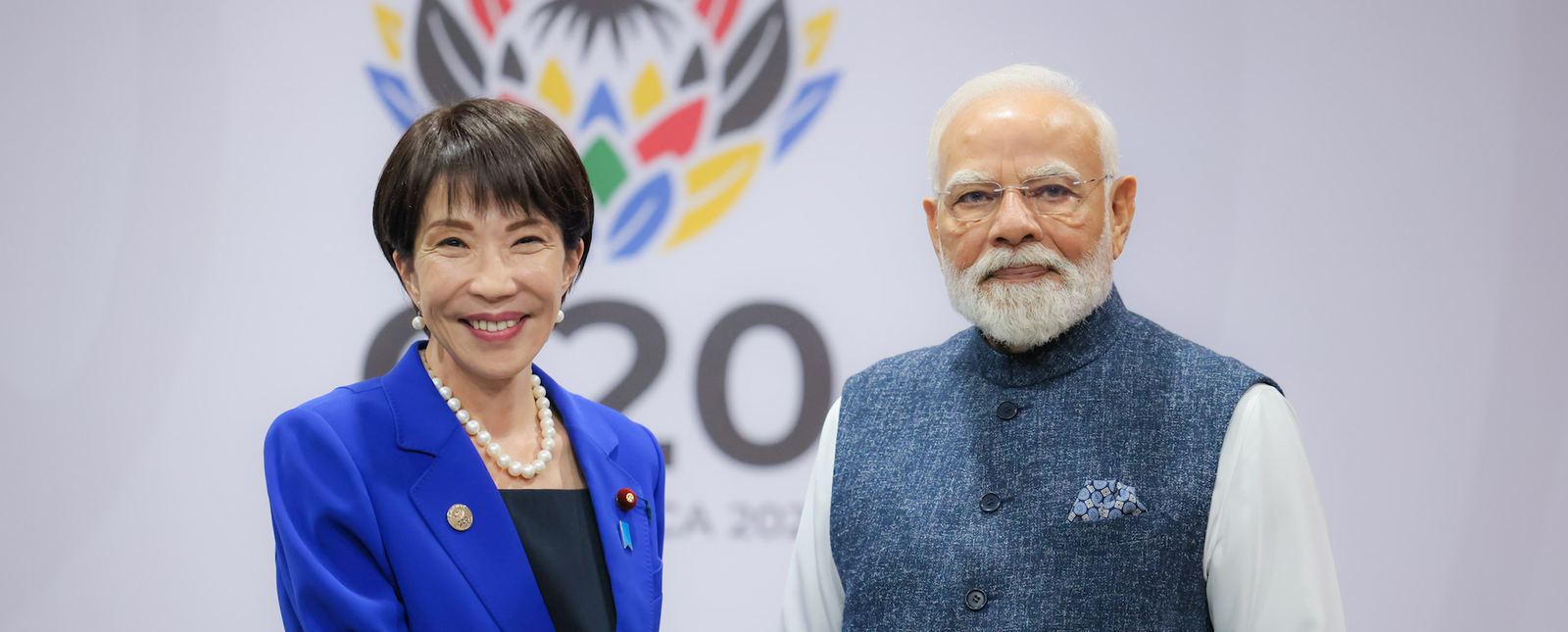
As strategic uncertainty grows across the Indo-Pacific, one conclusion emerged clearly from Prime Minister Sanae Takaichi’s visit to New Delhi on July 2nd: while many capitals are hedging, Tokyo is doubling down on India.
The symbolism was impossible to miss. Following in the footsteps of Shinzo Abe, who Takaichi considered an “elder brother”, and who had a close personal relationship with Modi, she mentioned she now considers the Indian PM her “brother” too. Modi then responded warmly referring to Taikaichi as a “younger sister”. The unusual exchange conveyed more than personal chemistry. It reflected the extraordinary level of trust that has become the foundation of one of Asia’s most consequential strategic partnerships.
Japan’s relationship with India did not begin with this summit. Abe invested enormous political capital in building ties with Modi, elevating the partnership from a promising bilateral relationship to a pillar of regional strategy. His successors continued that course. Fumio Kishida’s visits to India reinforced Japan’s commitment to a Free and Open Indo-Pacific (FOIP) and to closer cooperation with New Delhi as a leading democratic power in Asia. Takaichi’s visit demonstrates that this strategic consensus remains firmly intact.
Indeed, the summit renewed a shared commitment to both the Quad and the Free and Open Indo-Pacific vision. The joint statement welcomed the alignment of Takaichi’s updated FOIP concept and India’s own Indo-Pacific initiatives, while both leaders reaffirmed support for enhanced practical cooperation among the Quad partners. They also reiterated their determination to work toward an early convening of the next Quad Leaders’ Summit.
What makes this visit particularly significant, however, is that it was not merely about grand strategy. Unlike many diplomatic declarations, the Tokyo-New Delhi summit produced a remarkable list of tangible outcomes.
Japanese companies committed approximately ¥2 trillion ($12.5 billion) in new investment aimed at business creation and industrial development in India. More than 150 Japanese firms participated in the India-Japan Joint Economic Forum alongside senior corporate leaders accompanying Takaichi. The summit also generated over 120 business cooperation documents, including 129 agreements between companies from both countries.
Economic security emerged as a central theme. Japan and India issued a Joint Declaration on Economic Security Cooperation focusing on semiconductors, critical minerals, information and communications technology, clean energy, and pharmaceuticals. The two governments also agreed to strengthen battery supply chains through a new memorandum of cooperation, supporting Japanese investment and technological cooperation in India’s rapidly expanding electric vehicle sector.
The energy dimension was equally ambitious. The leaders launched a new framework to support India’s goal of establishing 1,000 biogas plants nationwide, helping rural development while creating opportunities for Japanese technology and vehicle manufacturers. They also advanced cooperation on hydrogen, green ammonia, energy storage, and strategic petroleum reserves, reflecting a shared understanding that energy security is becoming inseparable from national security.
The partnership is increasingly extending into advanced technology and defense. The countries agreed in principle on Japan’s first defense equipment transfer to India under their 2015 agreement, involving the UNICORN communications antenna system. Developed by Japanese industry and deployed on Mogami-class warships, the system symbolizes a growing willingness by Tokyo and New Delhi to translate strategic trust into practical security cooperation.
Just as importantly, the summit confirmed sustained strategic alignment. The joint statement described India and Japan as “natural and indispensable partners” and committed both sides to deepening cooperation on defense, economic security, technology, supply chains, maritime security, and regional stability. The leaders instructed their foreign and defense ministers to convene the next Japan-India 2+2 Ministerial Meeting in Tokyo before the end of the year, ensuring that the momentum generated in New Delhi will continue.
For Japan, the logic is straightforward. India is the world’s fastest-growing major economy, a fellow democracy, and an increasingly indispensable partner in preserving a rules-based Indo-Pacific order. For India, Japan remains a trusted source of investment, technology, infrastructure expertise, and strategic support.
At a moment when many countries are recalibrating their approaches to Asia, Tokyo has delivered a clear message. Japan sees India not merely as a market, or even as a strategic partner, but as an essential pillar of its vision for the future of the Indo-Pacific.
Washington may sometimes appear distracted. Tokyo is not. Japan is betting on India—and judging by the results of this summit, it is making that bet with increasing confidence.
Erik Lenhart (erik.lenhart1@gmail.com) holds an MA in political science from Charles University. He is a former Deputy Chief of Mission of the Slovak Republic in Tokyo and the author of the award-winning novel Daughters of the Empire.
Michael Tkacik (mtkacik@sfasu.edu) holds a PhD from the University of Maryland and a JD from Duke University. He is a professor of government and director of the School of Honors at Stephen F. Austin State University, the University of Texas system.




